


Prolonged drought is increasingly being treated as a visible climate risk—dried rivers, failing crops, water restrictions—but its most expensive consequence may be happening quietly beneath houses. As soils dry out, especially clay-rich soils, they contract; when that contraction is uneven, foundations can settle at different rates. The result can be diagonal cracks, sticking doors, gaps around windows and, in severe cases, structural instability.
The issue seems to be surfacing Europe-wide. Reports from Hungary, Britain and parts of the Netherlands describe buildings sinking as heatwaves and drought cause clay soils to shrink, while experts warn that the same mechanism can affect more and more properties in countries with extensive clay layers in the depth of traditional foundation ground levels. For homeowners, the immediate concern is repair cost; for insurers, it is a slowly developing, climate-linked risk that does not fit neatly into the traditional definition of a sudden, accidental insured event.
The Hidden Physical Mechanism
Clay behaves very differently from sand or gravel. Its fine particles and mineral structure give it a large surface area that can hold and release water, which means its volume changes substantially with moisture content. When rainfall is plentiful, clay swells; during a long dry spell, it loses water and shrinks. This is not a minor effect: the drying of a saturated soil reduces its volume progressively, and certain clay minerals and organic soils can exhibit particularly pronounced shrinkage.
Geotechnical Engineering academic materials identify excessive settlement, excessive heave and excessive lateral movement as key serviceability and safety concerns in foundation design. It also specifically treats volume-changing clays and subsidence-prone soils as materials whose condition can change after construction, causing uneven movement and damage to the structure.
Drought turns this textbook risk into a live hazard. As evaporation removes moisture from the upper soil layers, the shallow ground beneath a house can dry first. Trees, hedges and other vegetation accelerate the process by extracting water through their roots. If one side of a building sits over a drying clay zone—because of a large tree, a sun-exposed façade, poor drainage or a locally deeper foundation—while the other side remains wetter, the soil under the two sides shrinks by different amounts.
That is the crucial point: uniform settlement is usually less damaging than differential settlement. If an entire house moved down by the same small amount, the structure might tolerate it. But when one corner drops more than another, the building is effectively twisted. The foundation, walls, floors and roof are forced to accommodate a distortion they were not designed for.
A sustained fall in the water table can amplify the problem. Readings by the Hungarian national water authority show that groundwater levels fell by 1-2 metres in some lowland areas over recent years. A deeper water table means a thicker unsaturated zone, more opportunity for clay to dry, and a longer path for moisture to return during wet periods.
Structural Damage to Residential Buildings
The first signs are often easy to dismiss. A hairline crack above a window, a door that needs lifting slightly, or a small gap between a skirting board and the floor can look like ordinary ageing or poor workmanship. But drought-related foundation movement tends to produce recognisable patterns: diagonal cracks, often approaching 45 degrees; cracks that reopen after cosmetic repair; and damage that appears in several rooms or on several walls rather than in one isolated place.
These patterns arise because masonry and concrete are relatively strong in compression but weak in tension and shear. When one part of a house settles more than another, the walls are stretched and sheared. Diagonal cracks commonly follow the weakest planes in the masonry, such as mortar joints, openings and corners. As the movement continues, cracks widen, doors and windows distort in their frames, and floors can become visibly sloped.
Geotechnical Engineering distinguishes between total settlement and settlement differences. A foundation may be structurally capable of carrying the load, yet still fail the building’s serviceability requirements if the difference in movement between parts of the structure becomes too large. In practical terms, a house does not need to collapse to become a serious problem; it may become unsafe, difficult to insure, expensive to sell, or costly to repair.
Many of the homes, predominantly the single family homes commonly are low-rise, one- or two-storey buildings with relatively light structures — precisely the type that can be more sensitive to uneven ground movement. A basement or cellar can sometimes place the foundation deeper, reducing direct exposure to surface drying. But this is not an automatic solution: basement walls and floors can still lie within the seasonally active moisture zone. In many areas, high groundwater levels made basements expensive to build, waterproof and maintain, so numerous houses were constructed with shallow foundations and no basement.
Clay shrinkage can also interact with other weaknesses. Poor rainwater drainage, leaking pipes, tree roots, inadequate original foundations and dynamic loads from traffic or industry can make the movement worse or create localised zones of soil disturbance. This matters for diagnosis: an insurer or engineer cannot simply assume that every crack during a drought is caused by climate change! They must establish whether the movement is progressive, whether it correlates with drying, and whether another mechanism (such as a concealed pipe leak) is responsible.
The financial exposure can be substantial. Repairing subsidence-related damage without demolition may require soil injection, with costs that can reach several thousand Euros, even tens of thousands, depending on the building’s condition. The underlying problem is also slow: a homeowner may notice only one crack initially, while the movement has been developing for months or years.
A Legacy Built Before the New Climate
Tree-ring and climate research indicates that severe European droughts and heatwaves since 2014/2015 rank among the most extreme in 2,000 years, with major dry spells and heatwaves continuing through recent years such as 2022, 2024 and 2026. (see also Esper, J., Torbenson, M. & Büntgen, U. 2023 summer warmth unparalleled over the past 2,000 years. Nature 631, 94–97 (2024))
A large share of Europe’s existing housing stock, approx. 80%, was built before the common European standards series, the Eurocodes, that were developed in the early 2000s, and are in effect currently for design of building foundations as well. (see picture below and link provided, data by European Comission)
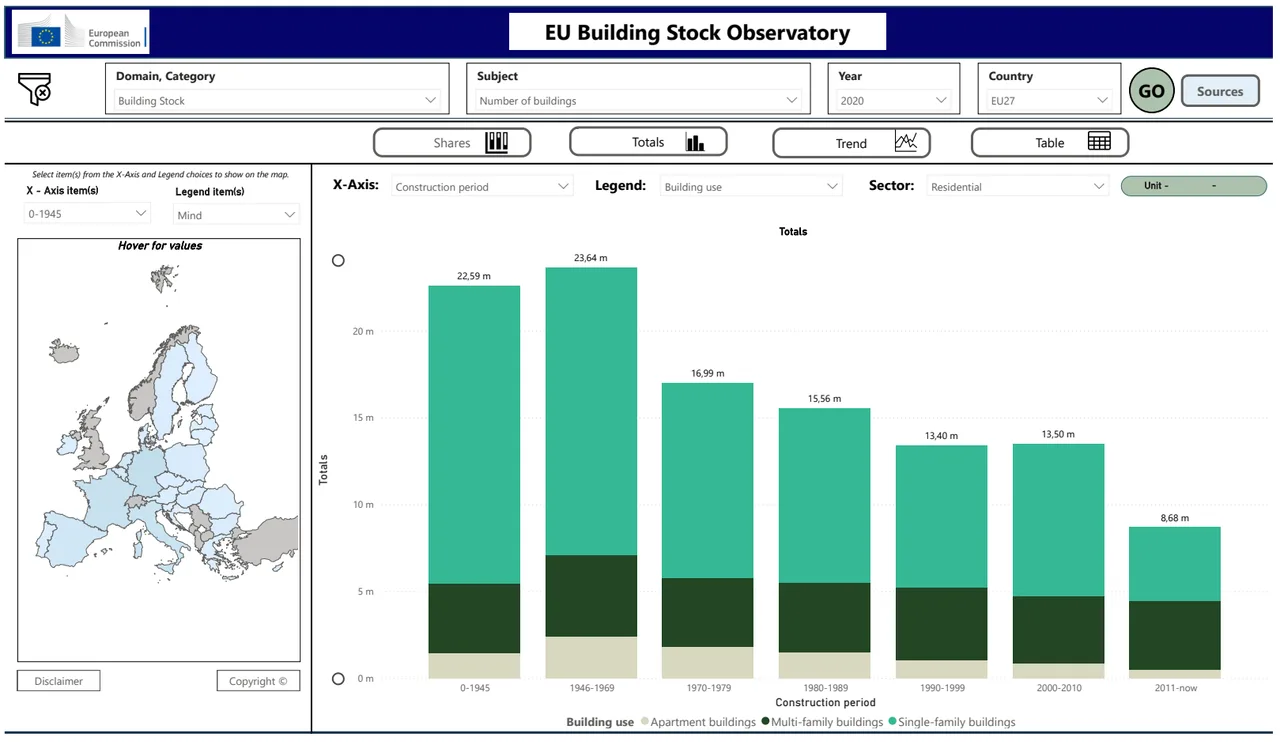
Chart on number of residential buildings in EU by construction period
These buildings were designed according to the national regulations, local engineering practice, construction customs and, in many cases, relatively simple soil investigations of their time. This did not necessarily mean faulty design: under the usual, more predictable climatic conditions, groundwater levels and construction costs of the period, many solutions performed well for decades.
The Eurocodes generally give a risk- and probability driven design procedure, which is moderner and gives more space to employ probability data in the calculations. They require designers to consider clay shrinkage and swelling, the influence of trees, groundwater conditions and prolonged drought. So the new standards seem to be more futureproof, rest assured that the designers of future buildings use the most updated climate records.
The problem is that the designers of many existing buildings could not necessarily anticipate today’s longer and more intense droughts, because these extreme weather records have emerged relatively recently. Climate conditions have changed, while the foundations beneath many homes have not.
The Unexpected Impact on the Insurance Market
Insurance is built around a deceptively simple distinction: it normally covers sudden, unforeseen and accidental events, not gradual deterioration. Drought-induced clay shrinkage sits awkwardly on the wrong side of that line. The ground does not fail in one dramatic moment; it dries, contracts and moves over weeks, months or years.
That is why many standard home-insurance policies do not cover damage caused by gradual soil shrinkage or subsidence associated with drought. Insurers may commonly treat sudden, unexpected, accident-like damage as an insured event, whereas progressive settlement caused by soil shrinkage generally does not qualify. The practical result is a widening gap between the physical risk and the financial protection homeowners believe they have.
This creates pressure in several directions. First, homeowners face repair bills that may not be covered, even when the damage is real and climate-linked. Second, insurers face a growing category of claims that are difficult to underwrite because the loss depends on soil type, tree cover, drainage, foundation depth, building age and local groundwater conditions. Third, reinsurers (the companies that absorb part of insurers’ large losses) may price climate-related risks more expensively, feeding through into premiums and coverage conditions.
The likely market response is not necessarily a blanket refusal to insure. More plausibly, insurers will become more selective: higher premiums or larger deductibles in high-risk clay areas, stricter survey requirements, exclusions for gradual ground movement, and clearer wording about what counts as an insured subsidence event. Common sense anticipates exactly this dynamic: rising claims and reinsurance costs are expected to appear eventually in premiums and insurers’ willingness to underwrite certain risks.
There is also a fairness problem. A homeowner may have maintained a property responsibly, yet still be exposed because the house sits on shrinkable clay, has mature trees nearby, or was built with a shallow foundation decades ago. Even if all codes were honored during design and construction, climate change turns a site-specific geotechnical property into a systemic financial risk. The appropriate response cannot be only “read your policy”; it must include better risk mapping, transparent policy wording and prevention incentives.
Opinion: This Is A Risk That Will Not Stay Underground
Drought-related foundation damage is a classic “slow-onset” climate risk. It lacks the visual drama of a flood or storm, but it can impose large repair costs, reduce property values and expose a major weakness in household insurance. The physical process is well understood: clay dries, shrinks unevenly, and moves the structure above it.
What is less settled is who pays. If standard policies continue to exclude gradual subsidence, many homeowners will carry the cost alone; if insurers broaden coverage without changing pricing and prevention, the cost will be spread across policyholders and may become unsustainable. The sensible middle ground is a combination of clearer exclusions and optional ground-movement cover, risk-based pricing, better soil and drainage data, and incentives for homeowners to manage moisture and vegetation around their properties.
The ground beneath a house may seem permanent. In a hotter, drier climate, it is not. Recognising that early, and taking it into account, before a crack becomes a structural claim, may be the cheapest form of insurance available.